2,200 words most frequently used in English
The Extreme English Basic course is a set of 2,200 basic words most commonly used in the English language. This course includes vocabulary items required for the following exams: Cambridge Young Learners of English (YLE) at all levels: Starters, Movers and Flyers, and Cambridge Key English Test (KET). This vocabulary range is necessary to communicate easily at A1 and A2 levels, according to The Common European Framework of Reference for Languages. With the use of the vocabulary at these levels, the learner can easily describe basically all the meanings in a given language. Mastering this set of vocabulary items allows the learners to understand the spoken and written language and to talk about basic everyday topics.
The light version of course is also available for download for mobile devices with the Windows Mobile operating system.
Features of the package:
- SuperMemo UX for vocabulary training, based on the SuperMemo method of repetition that has received numerous awards and whose effectiveness has been proven by research,
- over 2,000 words that are most frequently used in English and allow easy communication,
- comprehensive learner’s dictionary with definitions, synonyms, examples of use, illustrations and recordings,
- easy search and selection for learning of particular words according to:
- thematic categories, e.g. Animals, Food and drinks, Industry and work,
- exams (3 levels of YLE; KET),
- frequency in the language,
- common neighbouring words,
- selection of exercise types that let the user practise different skills, e.g. use in communication, correct spelling, listening comprehension,
- pronunciation trainer that analyses and evaluates the accent, intonation and other important speech parameters,
Content of the package:
- 2,200 words
- 13,000 exercises
- 5,400 examples
- 2 hours of recordings
| PUBLICATIONS IN THE EXTREME ENGLISH SERIES | ||
| 5,500 words 22,000 exercises 6,150 examples 6 hours of recordings |
![]() |
Words of low frequency that may be difficult to master even for native speakers |
| 9,800 words 59,000 exercises 12,900 examples 10 hours of recordings |
![]() |
Vocabulary of an educated native speaker that allows fluent expression on any subject |
| 9,800 words 59,000 exercises 18,500 examples 11 hours of recordings |
![]() |
Wide scope of vocabulary that allows coherent formulation of ideas and presentation of opinions |
| 2,200 words 13,000 exercises 5,400 examples 2 hours of recordings |
![]() |
Basic scope of vocabulary necessary for easy communication on everyday subjects |
| 7,400 exercises 10 hours of recordings |
![]() |
Exercises on grammar, irregular verb forms, phrasal verbs and idioms |
System requirements
Windows 2000 SP3 EN, XP EN, Vista EN, Windows 7 EN,Internet Explorer 7.0 or later,
512 MB RAM, CD-ROM,
sound card, 400 MB disc space.
There are 6 exercise types for each word:
- Say the word – exercise of the question-answer type,
- Complete the sentence – filling in gaps in sentences,
- Choose the correct word – choosing the correct option from a set of options in a sentence,
- Choose the correct definition – choosing the correct definition for a given word,
- Listen and say – exercise of the question-answer type based on understanding the definition in the recording,
- Listen and complete – writing in a word based on the definition in the recording.
All the definitions and instructions in the course are in British English. If a word has a popular American English equivalent or spelling, it is listed among the synonyms. All the words and definitions in the course have been recorded by British native speakers.
The SuperMemo application in brief
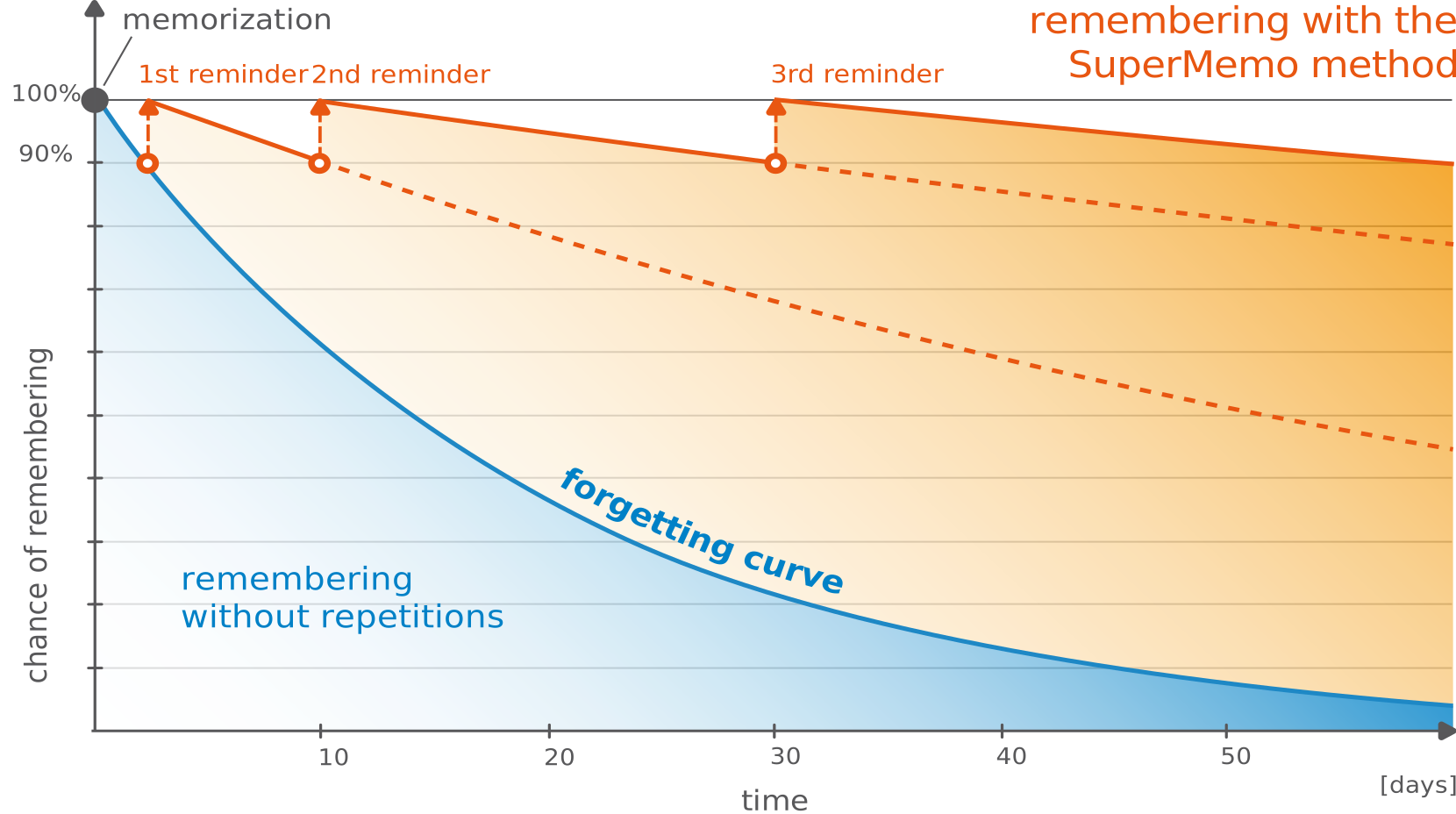
SuperMemo is a method of computer-aided learning based on research in long-term memory. The method has gained wide recognition and received numerous awards. It provides the learner with an optimum learning plan and repetition schedule, which allows to minimise the learning time with a nearly 100% knowledge retention.
A new generation of SuperMemo UX
A new generation of SuperMemo UX introduces new functionalities such as the possibility to:
- create an individual list of words to learn,
- search words and add them to the list,
- choose the the types of exercises and paths of learning.
SuperMemo and memory mechanisms
Non-deductive information requires repeating in order to be remembered. Statistically, a simple information item (like date, number, new foreign word) is remembered for up to several days without recalling it through usage, association or repetition. Successive repetitions tend to reinforce memory traces, therefore the intervals between repetitions necessary to keep information in the memory get longer.
SuperMemo effectiveness guarantee
Basing on the data from the learning process, SuperMemo assigns each information its current difficulty level and predicts how long you will remember it. Your next review is planned shortly before the expected moment of forgetting.
SuperMemo retention guarantee
With the Pronunciation Trainer in the SuperMemoUX application the speech you record yourself is automatically analysed in terms of stress, intonation, rhythm and other important articulatory parameters. Apart from the automatic assessment, amplitude graphs and spectrograms provide additional information about the correctness of the recording. You can also control the speed of the model native speaker’s recording.
See other courses from this category: